Sustainable Packaging
Compostable vs biodegradable packaging differs in standards, disposal conditions and claims. Learn what each label means and how to choose correctly.
Sustainable Packaging
Compostable vs biodegradable packaging differs in standards, disposal conditions and claims. Learn what each label means and how to choose correctly.
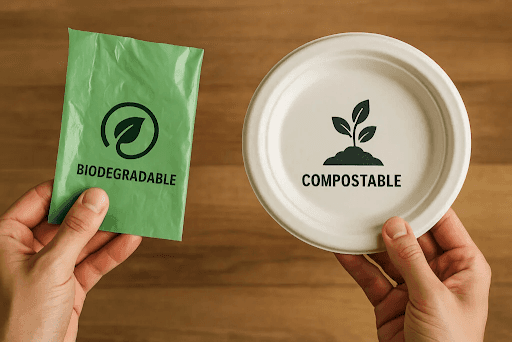
We see words like biodegradable, compostable and bio-based on packaging all the time. They sound similar enough that it is easy to assume they mean roughly the same thing.
They do not.
A biodegradable package may break down under certain environmental conditions, but that does not automatically mean it belongs in a compost bin. Compostable packaging has a more specific end-of-life route and usually needs defined conditions to break down properly.
For brands, packaging teams and consumers, understanding the difference matters because the label determines what should happen to the pack after use.
A biodegradable material can be broken down by microorganisms into simpler substances such as water, carbon dioxide and biomass.
But the word biodegradable alone does not tell us enough.
We still need to know:
Where will it biodegrade?
Under what temperature and moisture conditions?
How long will it take?
Will it fully biodegrade or simply fragment?
The European Bioplastics glossary explains that biodegradation depends on both the material and the environment it is exposed to. It also recommends that biodegradability claims specify the relevant timeframe and conditions.
This is why a package labelled biodegradable should not automatically be assumed to disappear quickly if it ends up in soil, landfill or the ocean.

Compostability is more specific.
A compostable material is designed to biodegrade under defined composting conditions within an expected timeframe, while also meeting requirements around disintegration and the quality of the resulting compost.
The current ISO 17088 standard for compostable plastics looks at four main areas: disintegration during composting, biodegradation, effects on terrestrial organisms and control of potentially problematic constituents.
That difference is important.
Biodegradable tells us that biological breakdown can happen. Compostable tells us much more about where and how that breakdown is intended to happen.
This is probably the simplest way to remember the distinction.
Compostability sits inside the broader idea of biodegradability.
A compostable material must biodegrade, but it also needs to do so under specified composting conditions and meet additional requirements.
A biodegradable material, on the other hand, may be designed to break down in soil, water or another environment. The conditions and timeframe can vary considerably.
The European Environment Agency’s briefing on biodegradable and compostable plastics explains that biodegradation depends heavily on temperature, moisture, oxygen, microorganisms and the amount of time the material spends in that environment.
That means the environment matters just as much as the material.
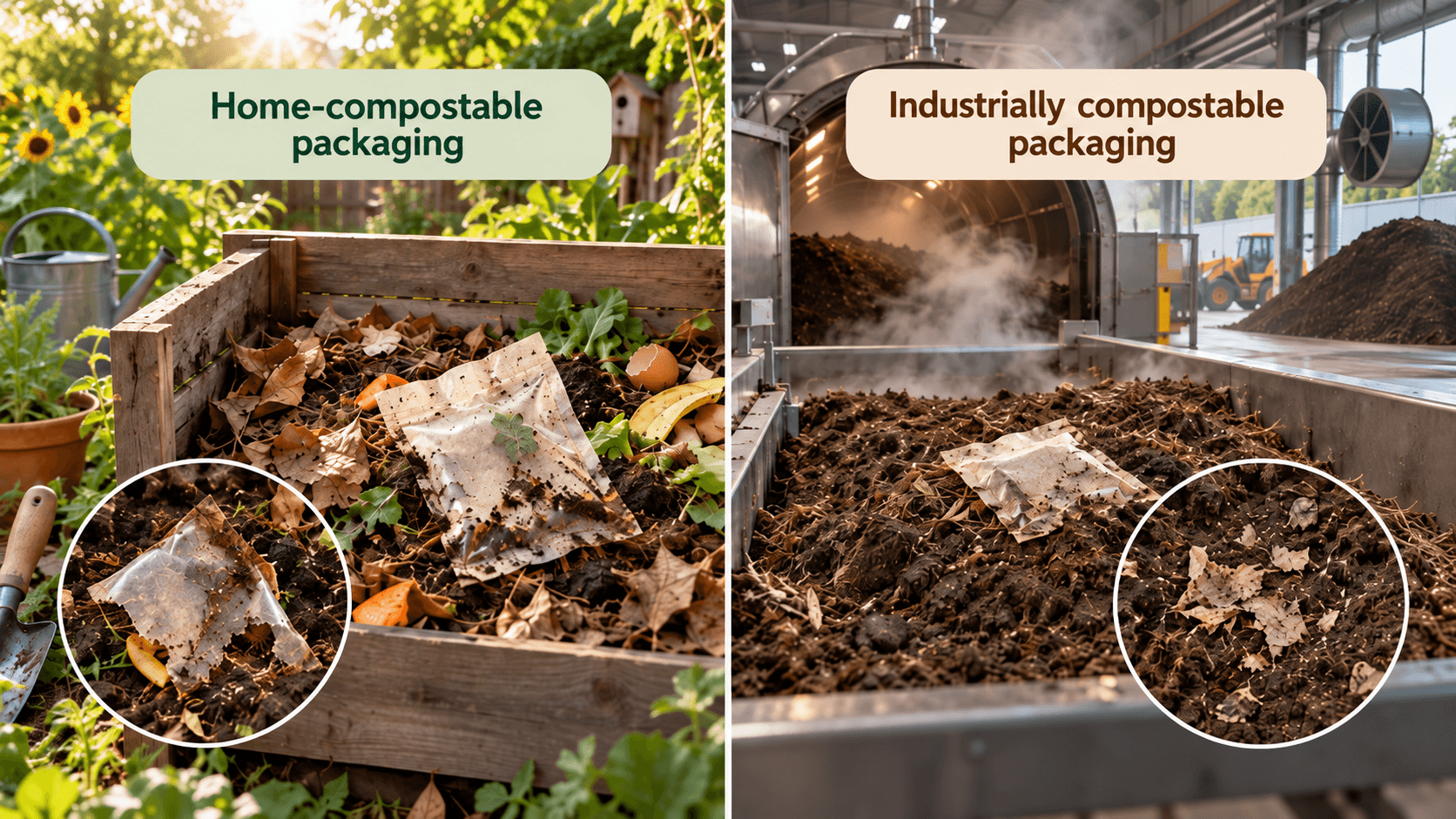
Even the word compostable needs another layer of explanation.
Home composting usually happens at lower and less predictable temperatures. The compost pile depends on the weather, moisture levels and how regularly it is managed.
Home-compostable packaging is designed to break down under these gentler conditions.
Industrial facilities operate under controlled conditions, with managed temperature, moisture, oxygen and processing times.
The ASTM D6400 standard applies to plastics designed for aerobic composting in municipal and industrial facilities where thermophilic, or high-temperature, conditions are achieved.
So an industrially compostable pack should not automatically be placed in a home compost pile.
The label needs to tell us which route it was designed for.
Another common assumption is that anything biodegradable must be made from plants.
That is not necessarily true.
Bio-based describes where the raw material comes from. A bio-based material is made partly or fully from biological resources rather than only fossil feedstocks.
Biodegradable describes what can happen to the material under certain environmental conditions.
The two properties are independent.
The European Environment Agency notes that biodegradable and compostable plastics can be made from either bio-based or fossil-derived raw materials. Similarly, a bio-based plastic may not be biodegradable at all.
So we should avoid treating “bio-based”, “biodegradable” and “compostable” as interchangeable sustainability labels.
For most of us, the distinction becomes practical when the packaging is empty.
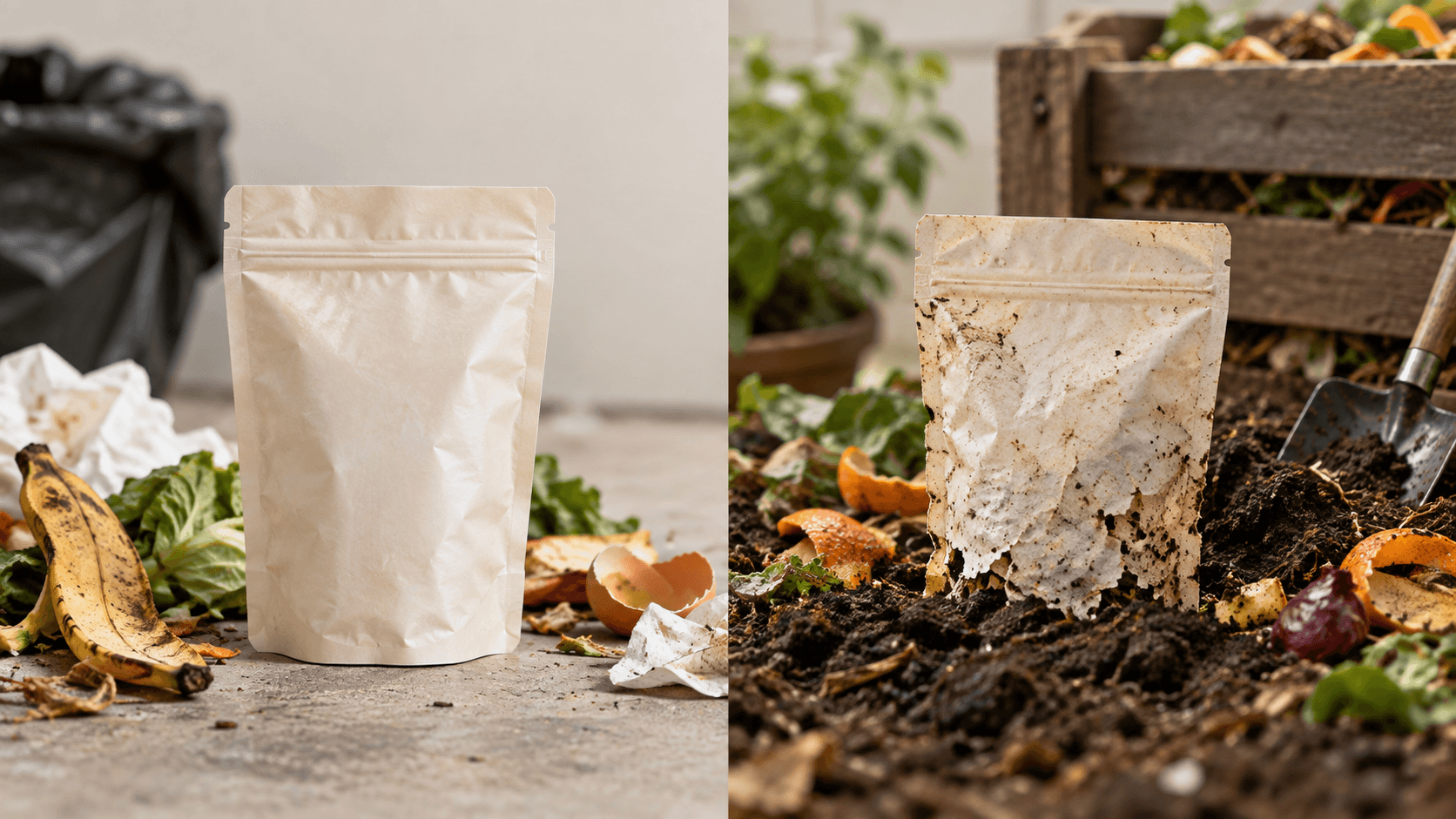
Imagine two food pouches.
One says biodegradable. The other says home compostable.
The second label gives us a clearer instruction. If the pack has been appropriately tested for home composting, it has been designed for that environment.
The first still leaves questions. Biodegradable where? Under what conditions? Within what timeframe?
That is why clear labelling matters.
A biodegradable pack placed in a home compost bin may not necessarily break down there. An industrially compostable pack may also remain largely intact if the pile never reaches the required conditions.
And neither label means the pack should be littered.
ISO’s organic recycling requirements for packaging specifically distinguish composting as a managed recovery route from packaging that simply ends up in the environment.
There is another part of this discussion that can get lost when we focus only on disposal.
Before any pouch becomes compost, it still has a job to do.
Food packaging may need to keep moisture out, limit oxygen exposure, resist oil and grease, protect aroma and form a reliable seal. It may also need to survive transport and run at speed on packaging machinery.
That means a compostable material is only useful if it provides the necessary performance during use.
This is particularly important for flexible food packaging. A package that has a good end-of-life route but causes the food inside to spoil sooner may create a different waste problem.
So the better question is not simply, “Is it compostable?”
We also need to ask: does it protect the product properly before it gets there?
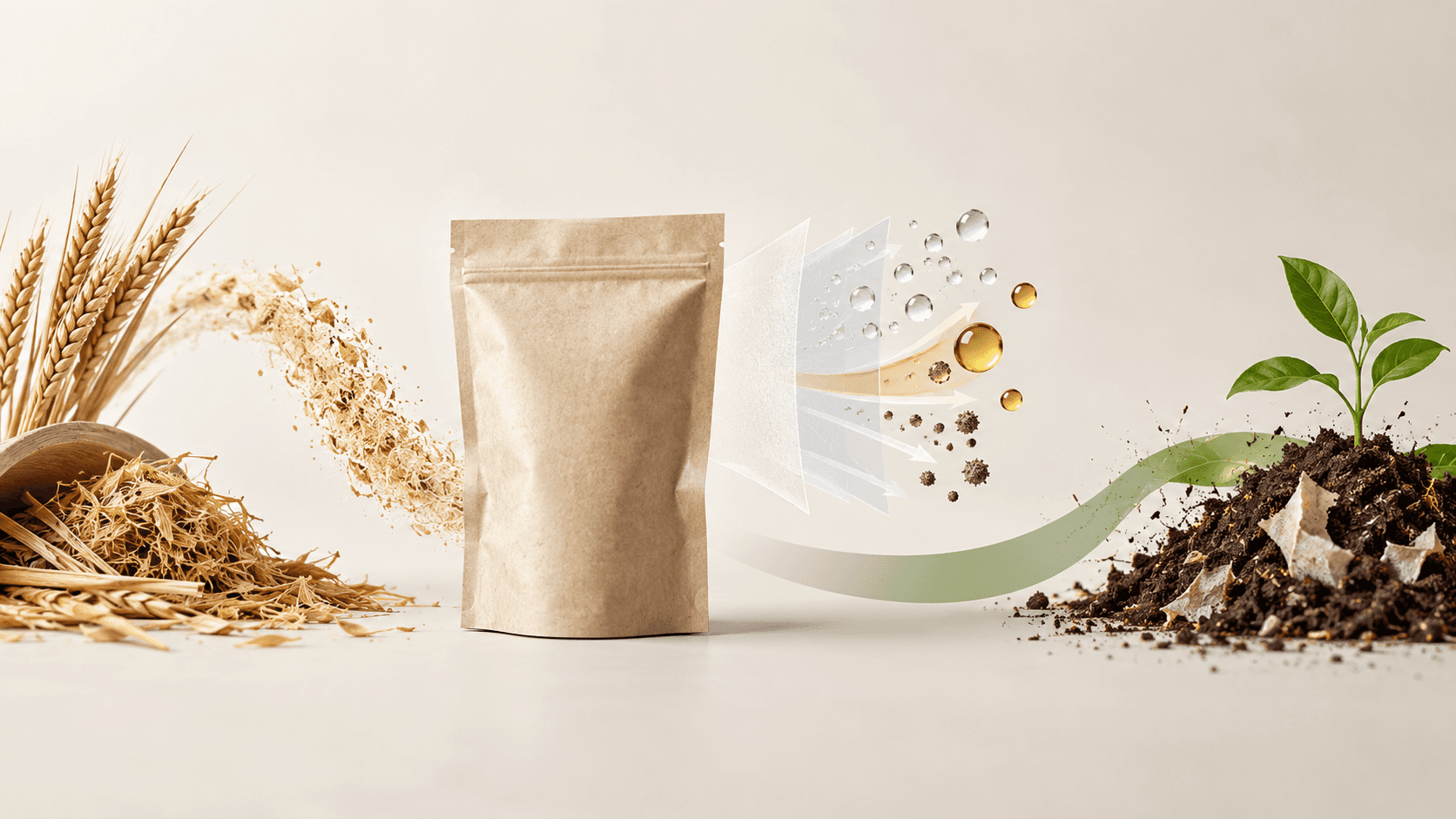
At Pippa, we are working on this balance between performance and end of life.
Our paper-based flexible packaging uses a bio-based coating made from agricultural waste. The coating is designed to provide water, oxygen, oil and grease barriers while also supporting heat sealing and form-fill-seal machinery.
Pippa is positioned as home compostable, rather than using the broader and less specific term biodegradable. Our website also lists the material as PFAS-free, made from agri-waste and designed for OTR and WVTR values below 1.
That distinction matters because clearer terminology helps packaging teams understand not only what a material is made from, but also what should happen to it after use.
So if there is one thing worth remembering, it is this:
Biodegradable describes the ability to break down. Compostable describes a more specific pathway for how that breakdown should happen.
No. Compostable packaging must biodegrade under defined composting conditions, while biodegradable is a broader term.
Not automatically. It should only be composted if the packaging specifically states that it is suitable for that composting environment.
No. Some compostable packaging requires the controlled conditions of an industrial composting facility.
Not necessarily. Biodegradation depends on factors such as oxygen, moisture, temperature and microbial activity.
Pippa positions its coated flexible packaging as home compostable.
Home compostable gives a more specific end-of-life route than the broader term biodegradable.
Pippa combines paper or biofilm substrates with a bio-based coating designed to support a home-compostable packaging structure.
Yes. Pippa’s coating is designed to provide water, oxygen, oil and grease barriers along with heat-sealing and FFS compatibility.
© 2026 Pippa • Privacy Policy • Terms & Conditions
Made with 💚 by Mission Sustainability