Learn what compostable packaging is, how it works, its main types, benefits, limitations and the difference between compostable and biodegradable.

Learn what compostable packaging is, how it works, its main types, benefits, limitations and the difference between compostable and biodegradable.
We finish using a food container, notice the word “compostable” on it, and pause. Does it go into the recycling bin? Can we add it to kitchen waste? Will it break down in a home compost pile, or does it need a specialised facility?
The label sounds simple, but the disposal route often is not. Compostable packaging can be useful, but only when the material, conditions and local waste system work together.
Compostable packaging is designed to break down through biological activity under defined composting conditions. With enough heat, moisture, oxygen and microbial activity, the material should disintegrate and biodegrade into water, carbon dioxide and biomass.
The important phrase here is “under defined conditions.” A compostable pack is not designed to disappear wherever it is thrown. The European Commission’s guidance on biobased, biodegradable and compostable plastics explains that compostable plastics usually need to be collected separately and sent to an appropriate composting system.
This means a compostable package may remain intact if it ends up in landfill, plastic recycling or an unsuitable compost pile.
Composting packaging is similar to composting food scraps, but the material must be designed for that environment.
The process usually happens in four stages:
The package enters a suitable composting environment.
Heat, moisture, oxygen and microorganisms begin acting on it.
The material loses its structure and starts to disintegrate.
Microorganisms convert it into water, carbon dioxide and biomass.
Breaking into small pieces is not enough. A material may fragment without fully biodegrading. A credible compostability claim should therefore consider both disintegration and biological breakdown.
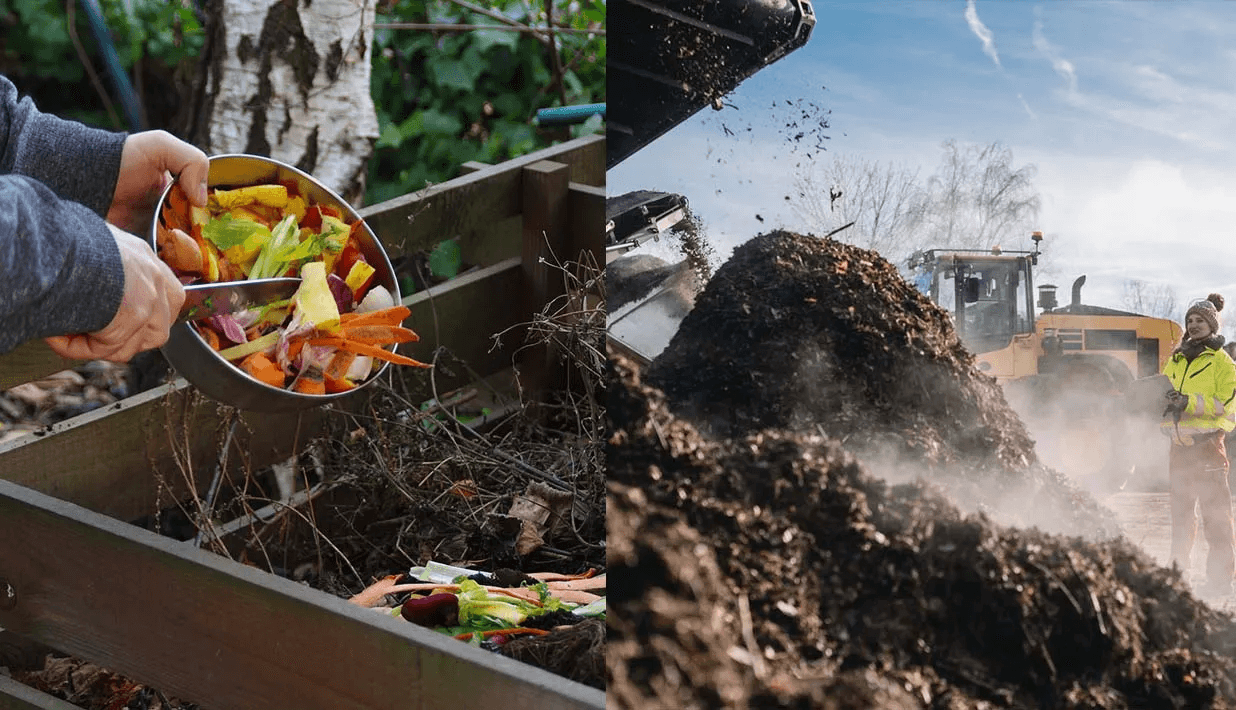
One of the first things we should check is whether the pack is home compostable or industrially compostable.
Industrial composting facilities maintain controlled temperatures, moisture, aeration, and regular turning. These managed conditions help materials break down faster and more consistently.
The ASTM D6400 standard for compostable plastics applies to plastics and plastic products designed for aerobic composting in municipal and industrial facilities.
An industrially compostable pack therefore needs to reach a suitable commercial facility. It may not break down properly in a home compost pile.
Home composting happens at lower and less predictable temperatures. The result depends on the weather, moisture, materials added, and how well the pile is managed.
Home-compostable packaging must therefore break down under gentler conditions. TÜV Austria’s guidance on home compostability explains that materials suitable for industrial composting may not break down in a garden compost bin because of the lower temperatures.
So, whenever we see the word compostable, the next question should be:
Compostable where?
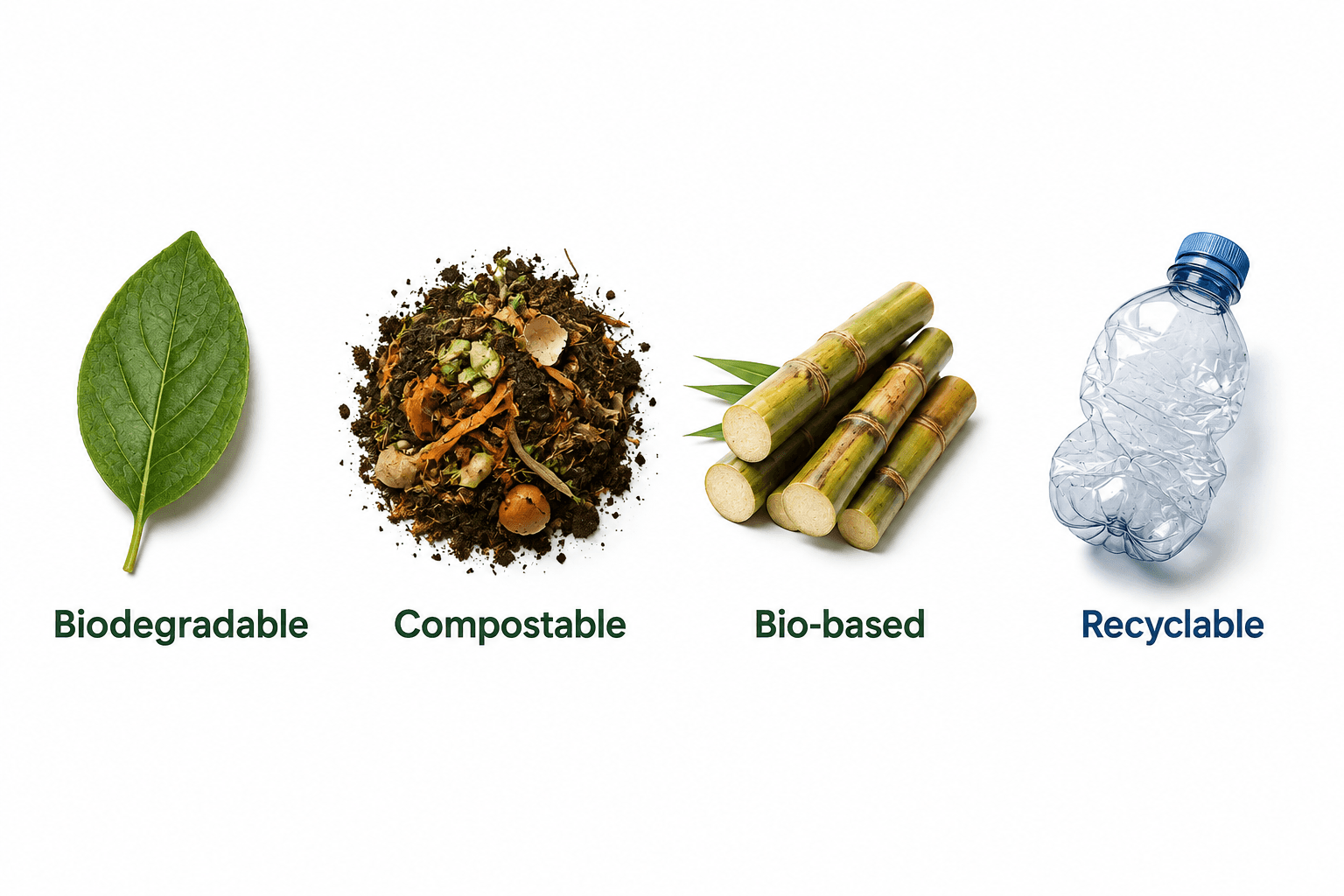
These terms are often used together, but they describe different properties.
Biodegradable: Microorganisms can break down the material, but the term alone does not explain how long it takes or what conditions are required.
Compostable: The material can biodegrade under defined composting conditions.
Bio-based: The material is made partly or fully from renewable biological resources.
Recyclable: The material is intended to be collected, sorted, and processed into usable material again.
A material can be bio-based without being compostable. It can also be compostable while containing some fossil-derived ingredients.
The European Bioplastics explanation of bioplastics makes this distinction clear: a bioplastic may be bio-based, biodegradable, or both.
There is no single material called compostable packaging. Depending on the application, it may use:
Paper or cellulose
Starch-based materials
PLA
PHA
Natural fibres
Compostable polymer blends
Agricultural-residue-based materials
Paper with compostable barrier coatings
The main material is only one part of the pack. Inks, adhesives, labels, coatings and closures also affect whether the complete package can follow the intended composting route.
A paper pouch with a conventional plastic lining, for example, cannot be judged only by its paper exterior.
Compostable packaging can be useful where the pack is likely to remain contaminated with food and may be difficult to recycle cleanly.
Potential benefits include:
Offering an end-of-life route for selected food-soiled packaging
Allowing some packaging and food residue to enter the same organic-waste stream
Reducing dependence on persistent conventional plastic
Supporting renewable or waste-derived materials
Encouraging brands to consider disposal during packaging design
These benefits only exist when the package reaches the right composting system. A compostable container sent to landfill has not followed its intended route. A compostable pack placed in plastic recycling may also contaminate that stream.
Image
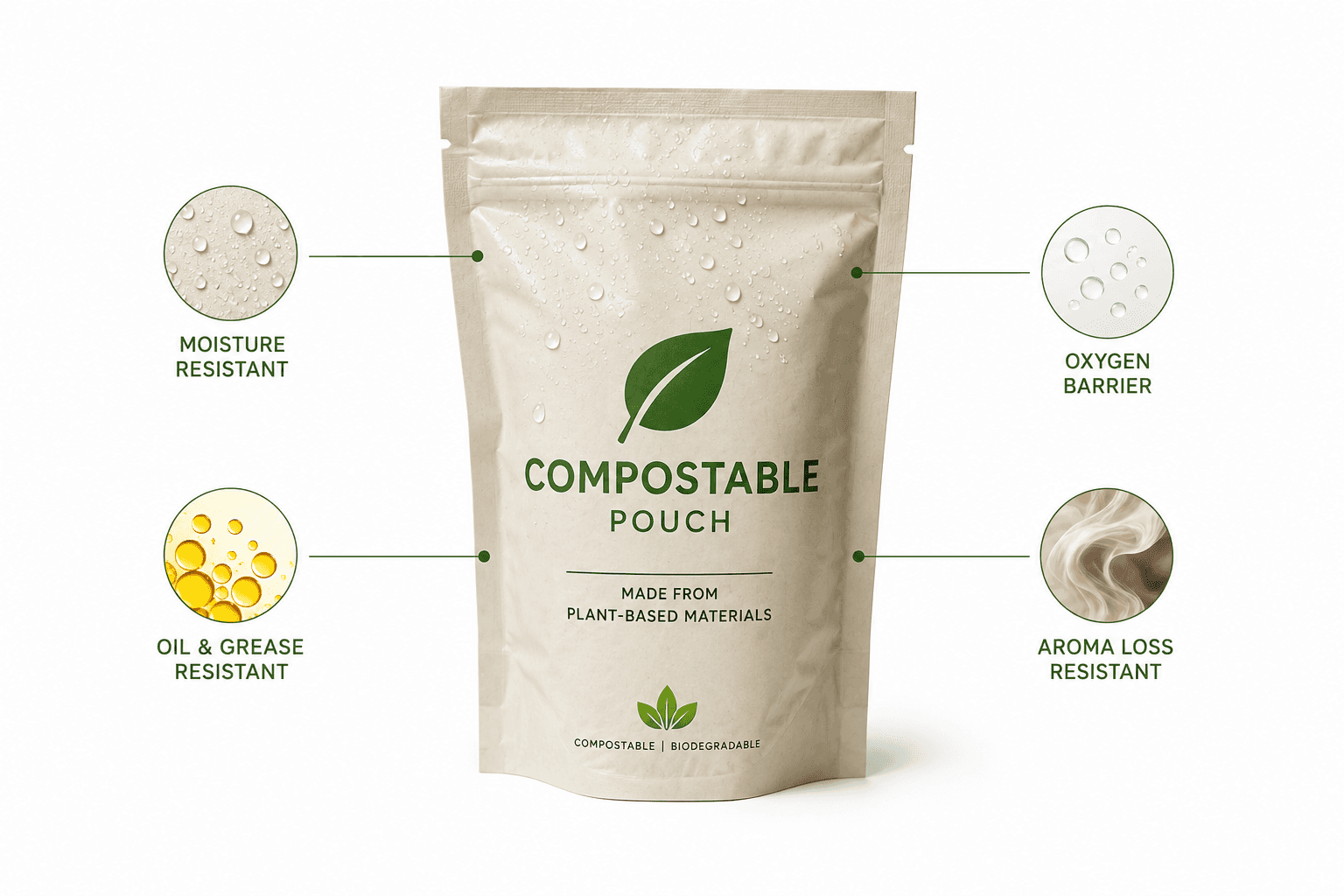
Compostable packaging should never be treated as something that can be discarded anywhere. It may not break down properly on roadsides, in the ocean, in a landfill or inside conventional plastic recycling.
It also still needs to perform as packaging. A compostable pouch may need to resist moisture, oxygen, oil, grease and aroma loss. It must seal properly, survive storage and transport and run on packaging machinery.
This balance matters. Packaging that breaks down after use but fails to protect the product may create more waste through leakage or spoilage.
WRAP’s guidance on compostable plastic packaging explains that compostable packaging is most useful when it is well designed, clearly labelled and supported by the right waste infrastructure.
Before discarding compostable packaging, we should:
Read the disposal instructions.
Check whether it is home or industrially compostable.
Look for recognised certification.
Confirm whether the local organic-waste collector accepts it.
Keep industrially compostable packaging out of home compost.
Avoid placing it in plastic recycling unless specifically instructed.
Never assume biodegradable means home compostable.
Clear instructions matter because compostable packaging only works when it reaches the environment it was designed for.
Image
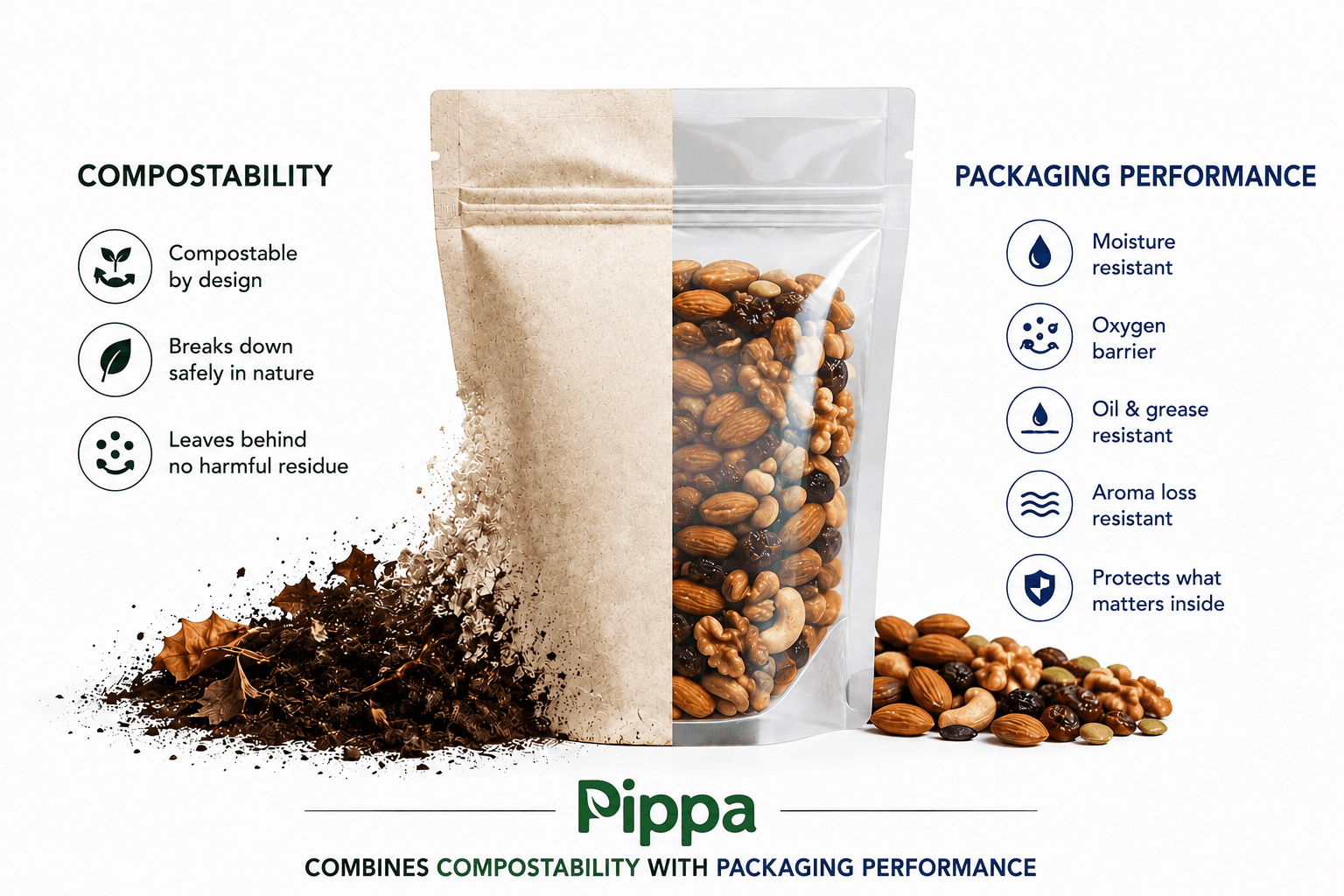
Pippa is developing paper-based flexible packaging supported by a bio-based coating made using agricultural waste. The coating is designed to provide water, oxygen, oil and grease barriers, along with heat-sealing and form-fill-seal compatibility.
Pippa also positions the material as PFAS-free and home compostable. The aim is to deliver several packaging functions through one coated structure rather than relying on multiple conventional plastic layers.
Each application still needs to be tested for shelf life, sealing, storage, transportation and machinery. For Pippa, compostability is not a standalone claim; it has to work alongside the performance the product needs.
Compostable packaging is designed to break down through microbial activity under specific composting conditions.
Home composting works at lower, less controlled temperatures, while industrial composting uses managed heat, moisture and aeration.
No. Biodegradable is a broader term, while compostable packaging must break down under defined composting conditions.
Usually not. It should follow the disposal instructions on the pack and enter an appropriate composting stream.
Pippa positions its paper-based flexible packaging as home compostable.
Pippa’s bio-based coating is made using agricultural waste streams.
Pippa states that its coating provides water, oxygen, oil and grease barrier performance.
Pippa states that its material is heat-sealable and compatible with form-fill-seal machinery, subject to application testing.
© 2026 Pippa • Privacy Policy • Terms & Conditions
Made with 💚 by Mission Sustainability