Agricultural waste packaging
Learn how agricultural waste such as straw, bagasse and fruit residues can be processed into fibres, biopolymers and packaging coatings.

Agricultural waste packaging
Learn how agricultural waste such as straw, bagasse and fruit residues can be processed into fibres, biopolymers and packaging coatings.
After rice is harvested, straw and husk remain. Sugarcane processing leaves behind bagasse. Corn gives us stalks and husks, while fruit processing generates peels, seeds and pulp.
We usually think of these materials as leftovers from agriculture. But inside them are cellulose, starch, lignin, pectin and other natural compounds that can become useful raw materials.
That is where agricultural-waste packaging begins.
The crop residue itself does not simply get pressed into a pouch. It first has to be cleaned, separated, processed and reformulated into something that packaging manufacturers can actually use.
Plants are naturally made from materials that give them structure, flexibility and protection.
Cellulose gives stems and fibres much of their strength. Starch can form films. Pectin, commonly found in fruit residues, has film-forming properties. Lignin helps give plants rigidity and also has interesting functional properties.
A recent review on plant-based agro-waste for food packaging identifies cellulose, hemicellulose, starch, pectin and lignin among the biopolymers that can be recovered from agricultural residues and developed into packaging materials.
So when we look at a pile of straw or fruit peel, we are really looking at a mixture of potential material ingredients.
The first challenge is getting them out.
Agricultural residue arrives with everything we would expect from a natural material: moisture, dirt, oils, sugars, and other plant components.
Before extracting anything useful, it generally needs some preparation. Depending on the feedstock and process, this can involve washing, drying, cutting, grinding or separating different fractions.
Think of sugarcane bagasse. It is not pure cellulose waiting to become packaging. Cellulose sits inside a larger plant structure alongside hemicellulose, lignin and other compounds.
The same is true of rice straw, wheat straw or corn stalks.
This preparation stage makes the material more consistent and gives the next extraction step better access to the component we actually want.
Once the residue is prepared, we can begin separating useful material from the rest of the plant.
The extraction route depends on what we want.
Crop straw, for example, can be processed to recover cellulose. Research on Recent advancements in crop straw cellulose describes physical, chemical and biological methods used to extract cellulose before it is further modified for films and coatings.
Fruit-processing waste can provide something different. Citrus peels and other fruit residues can be sources of pectin, which can be isolated and developed into film-forming materials.
This is why “agricultural waste” should not be thought of as one raw material.
Different residues contain different useful components, and those components can take very different routes into packaging.
Extracting cellulose or pectin is still not the same as making packaging.
The recovered material usually needs to be processed or formulated into a form that can be manufactured consistently.
This can lead to several different outcomes.
Cellulose fibres can become part of paper, moulded fibre or composite structures. Starch and pectin can be used in films or coatings. Plant-derived particles can act as fillers or reinforcements in another material. Extracted compounds can also be combined into functional formulations that are applied to an existing substrate.
The review Turning agricultural waste into packages for food describes agricultural residues being used as sources of monomers, fillers and functional additives, with processes ranging from film extrusion to thermoforming.
So there is no single route from farm residue to packaging.
The useful question is: what function can we create from the material we have extracted?
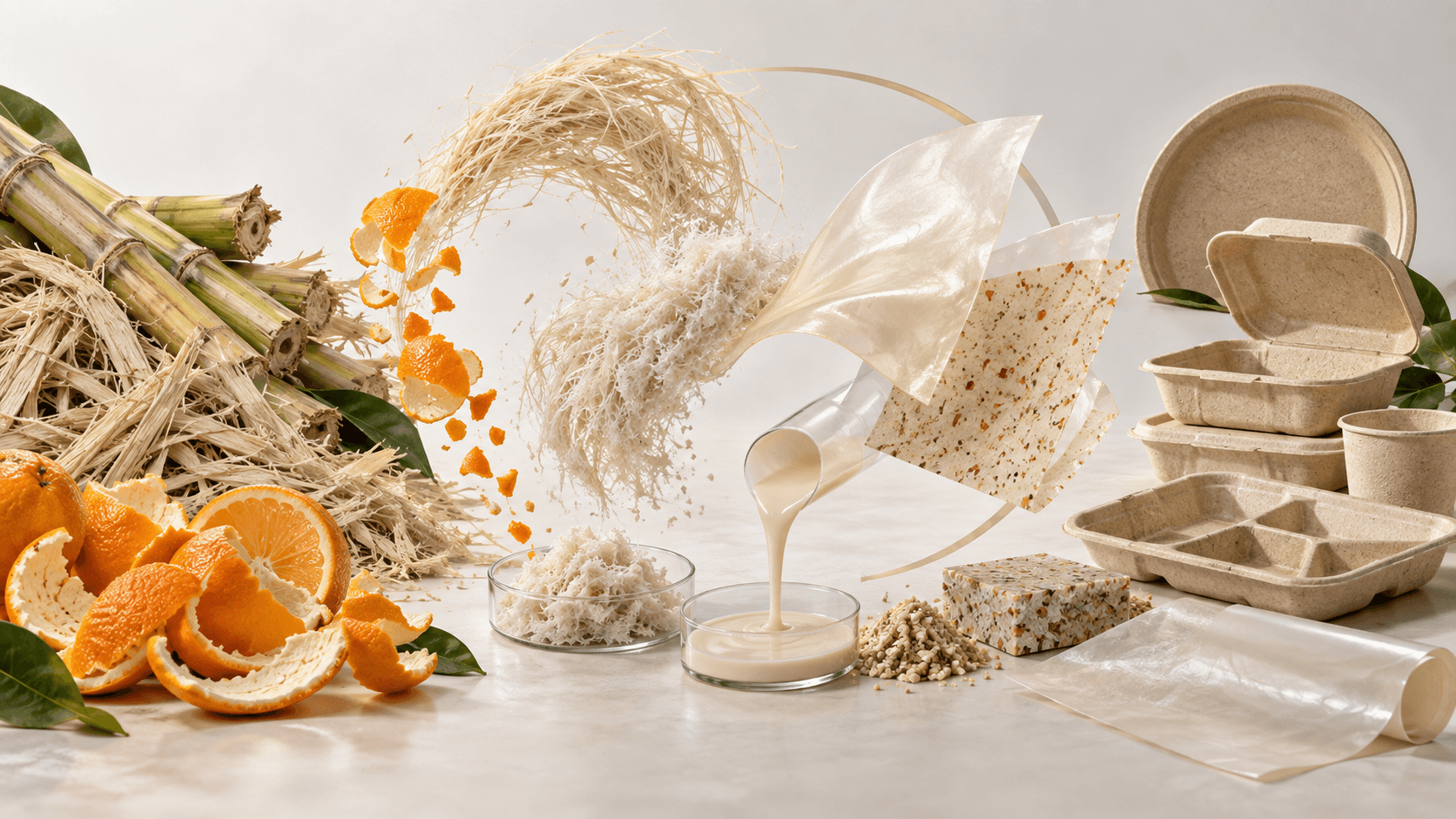
Consider sugarcane bagasse.
Its fibres can be used to create moulded food-service packaging such as trays and containers. But if we isolate and process its cellulose more deeply, that same agricultural source can contribute to films, composites or other material systems.
Fruit waste gives us another example. A citrus peel contains pectin, cellulose and other compounds. Depending on what is extracted, it could contribute to a film-forming polymer, a coating ingredient or a reinforcing material.
That is what makes agricultural waste interesting as a feedstock.
We are not searching for one universal replacement material. We are looking at what useful chemistry already exists in a residue and deciding how it can be used again.
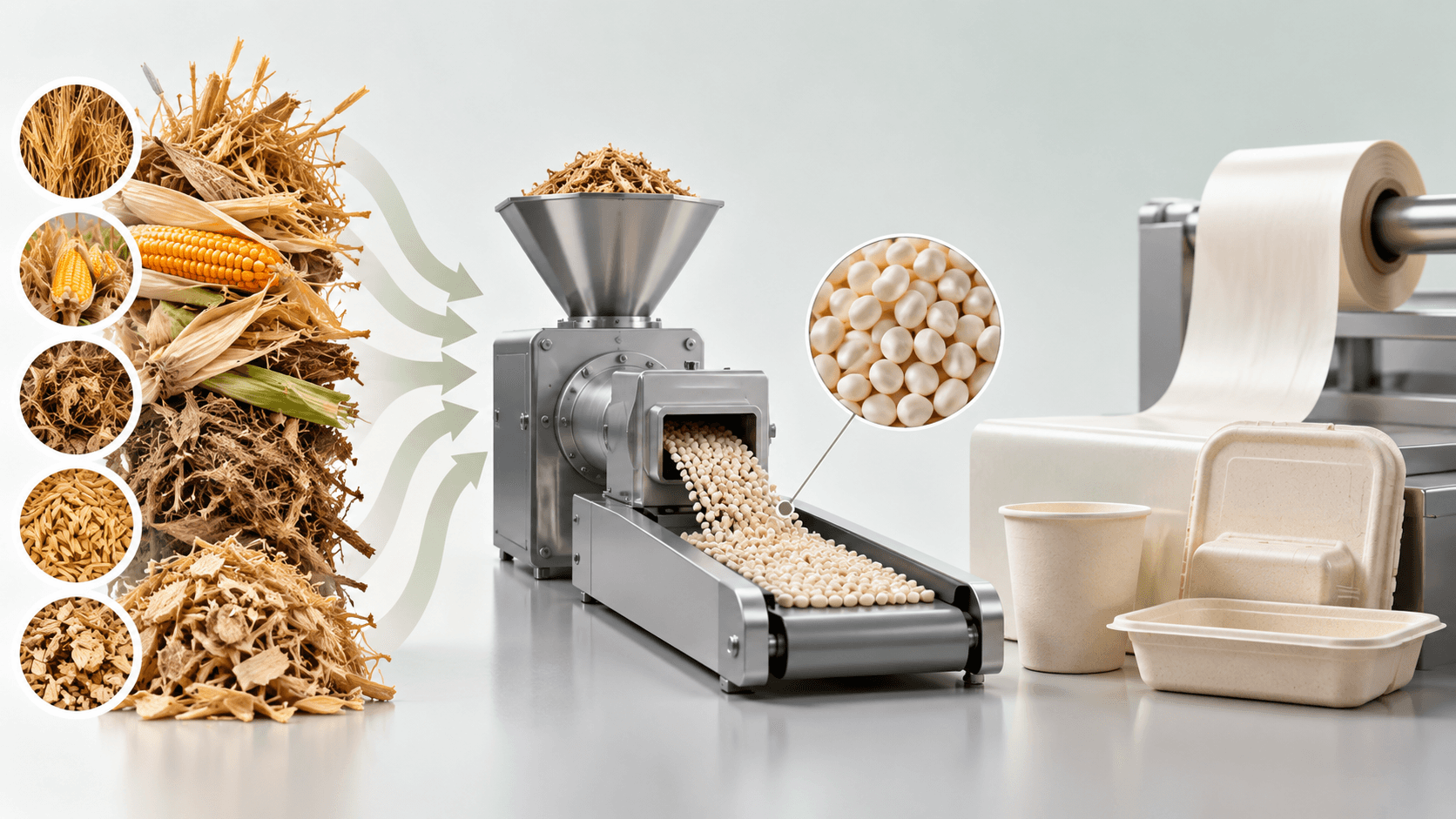
Packaging manufacturing relies on repeatability.
A machine cannot behave one way with Monday's batch of material and completely differently with Thursday's.
Agricultural residues, however, are naturally variable. Their composition can change with the crop variety, growing conditions, geography, season, harvesting method and processing history.
Even moisture content can change how a material behaves.
This means one of the less visible parts of waste valorisation is standardisation. The feedstock needs to be processed until the material entering production has predictable properties.
Research into agro-waste packaging repeatedly identifies scalability, raw-material variability and processing consistency as challenges when moving from laboratory development to commercial production.
Turning waste into packaging therefore requires more than finding a useful molecule. We also have to make that molecule reliable enough for manufacturing.
A small batch can prove that cellulose can form a film or that pectin can become a coating.
Commercial packaging asks a different set of questions.
Can the feedstock be sourced consistently? Can extraction happen efficiently at scale? Can the formulation be produced repeatedly? Does it remain stable during storage? Can it pass food-contact and migration requirements? Can existing manufacturing equipment process it reliably?
The 2025 review on Valorization of plant-based agro-waste into sustainable food packaging materials highlights scale-up, economic feasibility and regulatory requirements among the major challenges for wider adoption.
This is the part that separates an interesting research material from a packaging material that brands can actually buy and use.
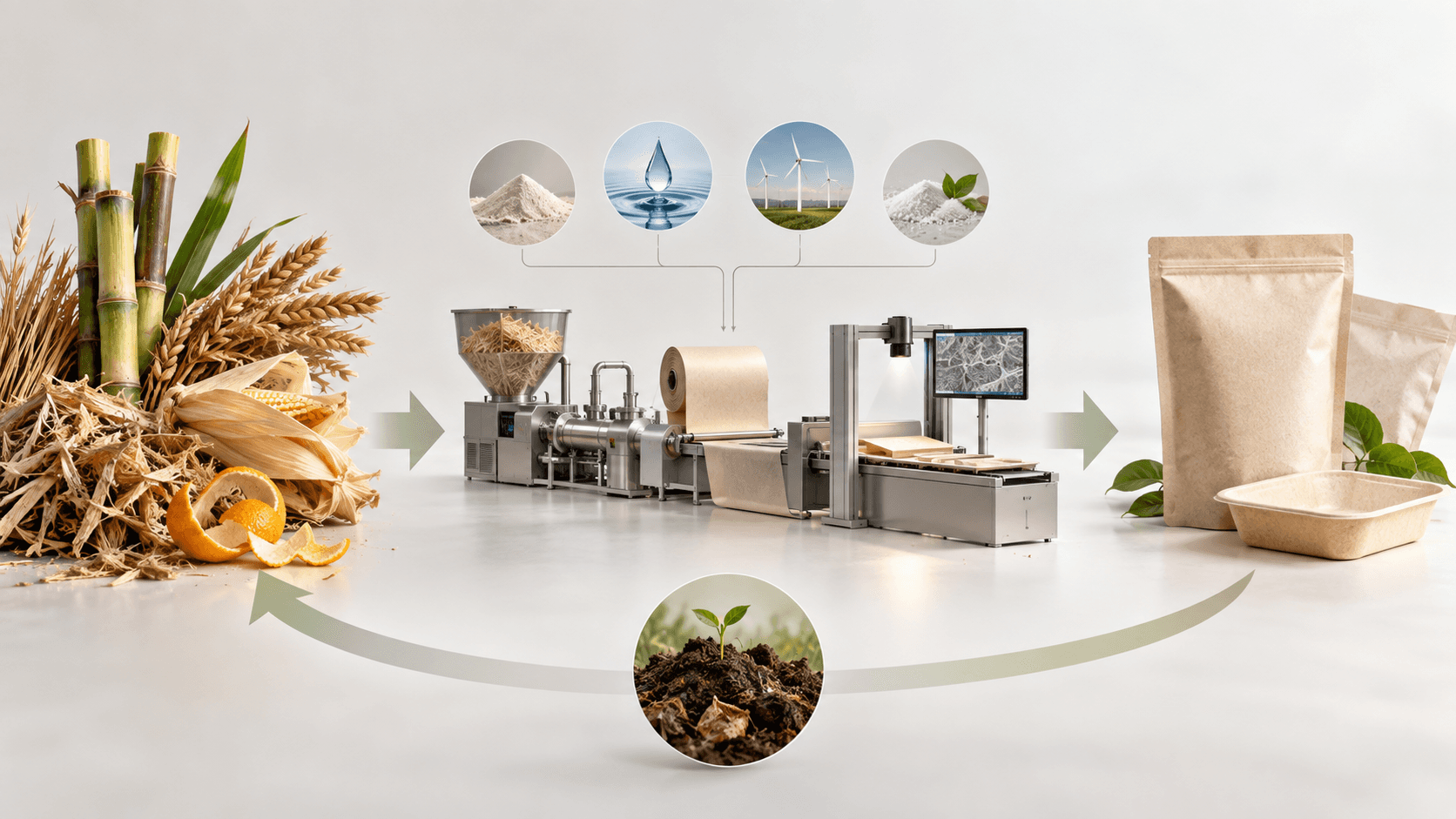
It is tempting to assume that using waste automatically makes a packaging material sustainable.
But the feedstock is only one part of the story.
We still need to consider how much processing is required, what other ingredients are added, how much energy and water are used, how the final packaging is manufactured and what happens to it after use.
That does not reduce the value of agricultural residues. It simply gives us a more useful way to evaluate them.
The opportunity is not just to replace one raw material with another. It is to take something that already exists as a by-product and find a higher-value use for the useful components inside it.
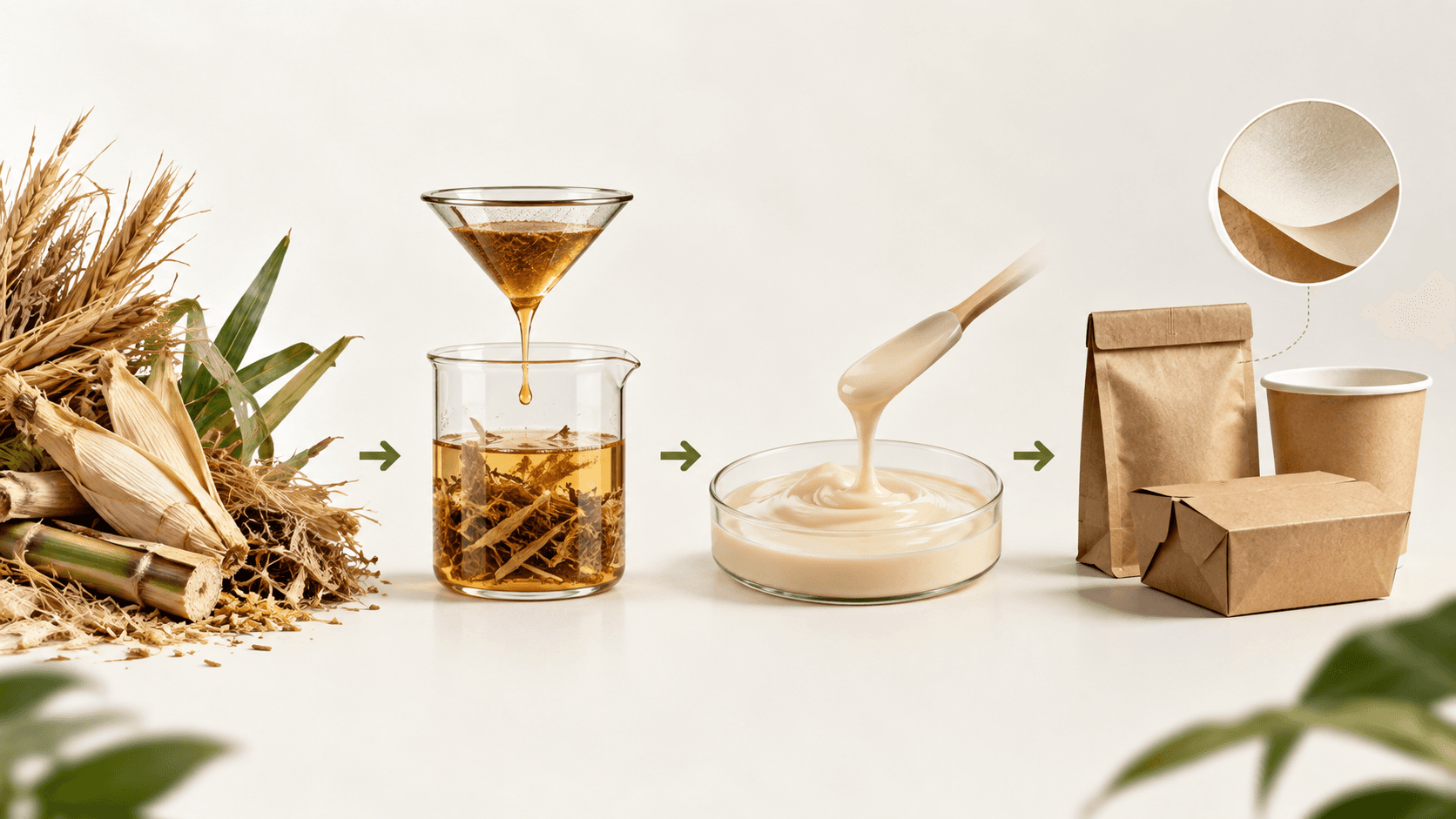
At Pippa, agricultural waste is the starting material for our coating, rather than the paper itself.
Our process follows a simple sequence:
Agricultural waste streams → Processing and extraction → Bio-coating formulation → Application onto paper packaging
We extract useful components from agricultural residues and formulate them into a bio-based coating. That coating is then applied to paper or biofilm substrates. Pippa's own material pathway shows these four stages from agricultural waste through to coated packaging.
The coating is where the agricultural residue gets its new job. Rather than remaining a low-value by-product, the extracted material becomes part of a functional packaging layer.
That is the part of waste-to-packaging that interests us most.
A crop residue does not need to look like packaging to become packaging.
Sometimes, the value is hidden inside it.
Agricultural waste can be processed to recover useful materials such as cellulose, starch, lignin and pectin, which can then be used in fibres, films, coatings or composites.
Residues such as sugarcane bagasse, rice straw, wheat straw, corn husks and fruit-processing waste can provide useful packaging feedstocks.
Usually not. The residue is first cleaned, processed and separated so useful components can be extracted and reformulated into packaging materials.
It contains natural polymers and fibres that can be recovered and given new functions instead of remaining low-value by-products.
Pippa extracts useful components from agricultural waste streams and formulates them into a bio-based coating for paper packaging.
No. Pippa uses agricultural waste primarily as the feedstock for its functional bio-coating, which is applied to paper or biofilm substrates.
The coating is designed to add functional packaging properties such as water, oxygen, oil and grease barriers.
Agricultural residues contain useful natural compounds that can be extracted and turned into higher-value packaging materials.
© 2026 Pippa • Privacy Policy • Terms & Conditions
Made with 💚 by Mission Sustainability